Home / Guides / Cheapest electric heaters to run in the UK
Cheapest electric heaters to run in the UK
A resistive heater costs whatever its wattage and your unit rate say. The “cheap” one is the lower wattage you can switch off sooner, not a brand with a secret efficiency.

Our top picks
Start here.
These are ways of solving the job, not scored products. An Amazon button opens a search. The price is whatever is on the page today.
1,500 W
Our pick for holding one room
Oil-filled radiator
Same heat per unit of electricity as any other resistive heater. It feels steadier because the thermostat cycles and the oil holds some warmth.
- Example running cost
- 1,500 W for 1 hour = 1.5 kWh × 32.69p/kWh = 49.04p An upper bound if the element drew 1,500 W for the whole hour. A thermostat usually means less.
- What actually changes the bill
- Average power and hours, not the badge on the front
Pros
- The surface stays warm after the element switches off
- A timer is what stops it running all evening
Flaws but not dealbreakers
- Slow to take the chill off a cold room
- Still about one unit of heat per unit of electricity

Our pick for a short blast
Fan heater
It delivers its labelled power quickly and stops when you switch it off. Left on, a 2 kW badge is an expensive hour.
- Example running cost
- 2,000 W for 20 minutes = 0.667 kWh × 32.69p/kWh = 21.79p Only if it really draws 2,000 W the whole time. Read the plate.
- Good for
- Twenty minutes in one room, not an afternoon
Pros
- Heat is immediate
- Nothing keeps warming after you switch it off
Flaws but not dealbreakers
- Easy to leave running
- A 3 kW model sits near the limit of a 13 amp plug
1,000 W
Our pick for a room on a timer
Panel heater
Treat it like the fan heater sum. The timer and the thermostat are the features that change the cost.
- Example running cost
- 1,000 W for 1 hour = 1 kWh × 32.69p/kWh = 32.69p Use the wattage printed on the heater you are looking at.
- Do not trust
- An eco badge that is not a lower wattage or a timer
Pros
- Quiet compared with a fan
- Can be set to a room you actually use
Flaws but not dealbreakers
- Heats the air, not a magic efficiency class
- Useless if the rest of the house still calls for heat
What it costs to run
Built from the cap file. One use is the wattage and time on the card. A day here means one such use. Thirty and 365 stack that same use. It is a maximum if the appliance drew that power the whole time.
| Example | One use | 30 uses | 365 uses |
|---|---|---|---|
| Oil-filled radiator1,500 W for 1 hour = 1.5 kWh × 32.69p/kWh = 49.04p | 49.04p | £14.71 | £178.98 |
| Fan heater2,000 W for 20 minutes = 0.667 kWh × 32.69p/kWh = 21.79p | 21.79p | £6.54 | £79.55 |
| Panel heater1,000 W for 1 hour = 1 kWh × 32.69p/kWh = 32.69p | 32.69p | £9.81 | £119.32 |
Based on the average electricity price cap rate of 32.69p/kWh for 1 January to 31 March 2027, Direct Debit, England, Scotland and Wales. Your rate varies. VAT is not included in this electricity rate until 30 June 2027. Northern Ireland is outside this cap. A nameplate sum is a maximum: many appliances cycle. Source: Ofgem price cap. Last updated 2026-11-25.
In pictures
Commons photographs of this kind of thing. None of them is the item behind a buy button.
-
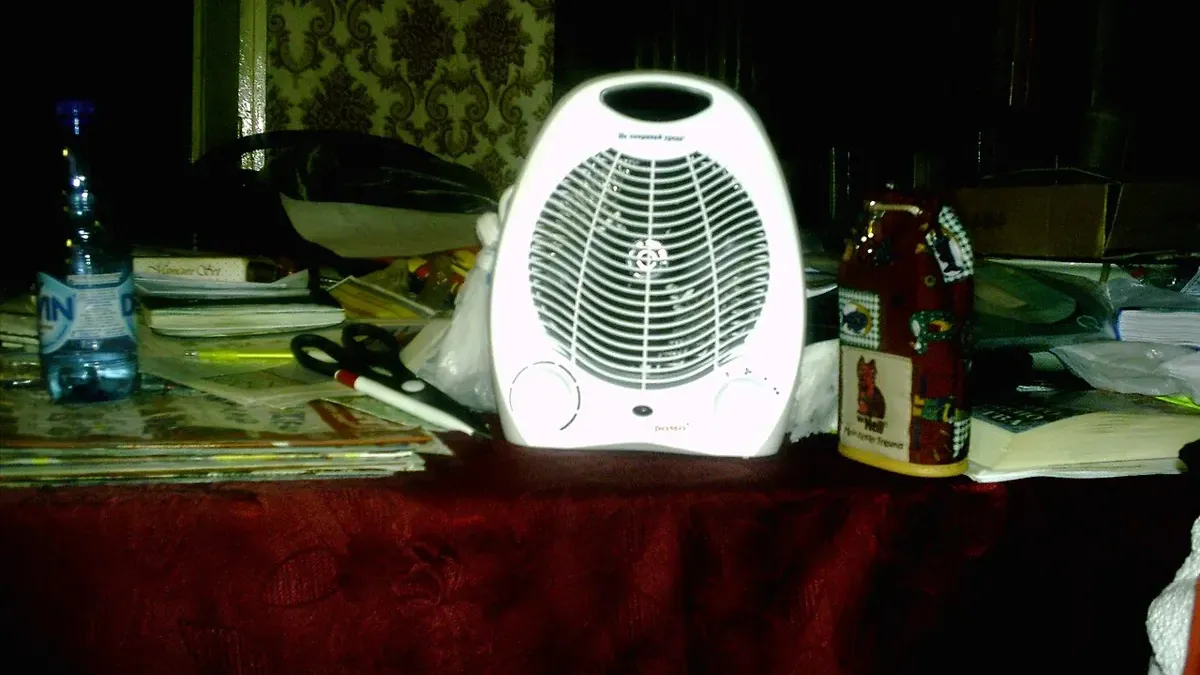
Example of a fan heater. Photo: Oleg Bor / Wikimedia Commons, CC BY-SA 4.0. -
Example of a fan heater. Photo: Antonio Mette / Wikimedia Commons, CC BY-SA 4.0. -
Example of a fan heater. Photo: Mehediabedin / Wikimedia Commons, CC BY-SA 4.0.


Watch: brand videos
The January 2027 cap rate is the one in these sums. It was 26.32p/kWh in 1 October to 31 December 2026. The change is set out in the January price cap note, and the hour-by-hour table is in running costs at that cap. Heating only the room you are in is the one-room note. Photograph the meter close to 1 January if you are on a default tariff: meter reading. Whether this cap applies at all is the fixed or variable note. The £100 Household Energy Payment is a separate England scheme. It does not change the unit rate.
The useful question is not “which heater is efficient”. A plug-in electric heater that warms a room by a resistance element — a fan heater, a convector, a panel, an oil-filled radiator, a ceramic heater, an infrared bar — turns the electricity it draws into heat. One kilowatt hour in is about one kilowatt hour of heat in the room. Brands do not get a special exemption from that.
What changes the bill is the power the heater actually draws, how long it draws it, and whether you are heating a person, a room, or a whole house. This note shows the sum. It does not score products.
The price cap is a rate, not a spending limit
Ofgem’s cap for 1 January to 31 March 2027 sets the maximum unit rate and standing charge on a default tariff in England, Scotland and Wales. It was announced on 25 November 2026. Ofgem said the following quarter would be announced by Ofgem will announce the following cap before 1 April 2027..
| How you pay | Illustrative annual bill | Typical use behind that figure |
|---|---|---|
| Direct Debit, if this cap lasted a year | £2,166 | Ofgem’s annualised figure for a typical dual-fuel household on the current Typical Domestic Consumption Values. It is not a cap on your bill. |
GB average Direct Debit rates for the same period
| Fuel | Unit rate | Standing charge |
|---|---|---|
| Electricity | 32.69p/kWh | 54.77p a day |
| Gas | 10.96p/kWh | 29.65p a day |
Announced by Ofgem on 25 November 2026. Ofgem will announce the following cap before 1 April 2027. These are GB average Direct Debit rates for 1 January to 31 March 2027. In 1 October to 31 December 2026 the electricity unit rate was 26.32p/kWh and the gas unit rate was 7.97p/kWh. Your postcode, meter and tariff can differ, and a fixed tariff is outside the cap. The illustrative bill is Ofgem’s annualised figure for a typical household if this cap lasted a year. It is not a ceiling on your total bill. Electricity rates do not include VAT until 2027-06-30. Gas rates include 5% VAT. Ofgem says the VAT change means costs cannot be compared directly with periods before October 2026. Northern Ireland is outside this cap. Sources: Ofgem — energy price cap will rise 26% from January 2027; Ofgem — energy price cap unit rates and standing charges; Ofgem — changes to the energy price cap, 1 January to 31 March 2027.
Read the electricity unit rate on your own bill before you use the examples below. A fixed deal can be different. Economy 7 has a peak rate and an off-peak rate; Ofgem says that together they cannot exceed the cap, but this page does not invent an off-peak price. If you live in Northern Ireland, the Ofgem cap does not apply. Use the rate from your supplier, and see the Utility Regulator.
The standing charge is not part of the cost of running a heater for an hour. You pay it whether the heater is on or not. Leave it out of the heater sum.
For this cap period the published electricity rate does not include VAT. VAT is removed from electricity bills until 2027-06-30. The gas rate still includes 5% VAT.
The sum
Watts are on the rating plate or in the manual. Hours are the time the heater is actually drawing that power, not the time you wish it was on.
Divide the watts by 1,000 to get kilowatts. Multiply by hours to get kilowatt hours. Multiply by the unit rate in pence. The examples use 32.69p/kWh, the GB average Direct Debit rate for this cap.
A label of 500 watts, if it really drew that for a full hour:
500 W for 1 hour = 0.5 kWh × 32.69p/kWh = 16.35p
A label of 1,000 watts for a full hour:
1,000 W for 1 hour = 1 kWh × 32.69p/kWh = 32.69p
A label of 1,500 watts for a full hour:
1,500 W for 1 hour = 1.5 kWh × 32.69p/kWh = 49.04p
A label of 2,000 watts for a full hour:
2,000 W for 1 hour = 2 kWh × 32.69p/kWh = 65.38p
A label of 3,000 watts for a full hour:
3,000 W for 1 hour = 3 kWh × 32.69p/kWh = 98.07p
A thermostat means the heater does not draw its nameplate power the whole time. If a 2,000 watt heater is drawing power for about half of an hour, the hour costs about the same as 1,000 watts flat out:
1,000 W for 1 hour = 1 kWh × 32.69p/kWh = 32.69p
You cannot see that duty cycle from the box. A plug-in energy monitor, on a heater that is safe to plug into one, is the honest measurement. The monitor note covers what to use, and what not to unscrew.
Four hours at a true 2,000 watts is a different bill from a short blast:
2,000 W for 4 hours = 8 kWh × 32.69p/kWh = £2.62 (261.52p)
That is the whole of the “cheap to run” question for a resistive heater. Lower watts, fewer hours, or both.
What the different shapes are for
An oil-filled radiator has a thermostat and some thermal mass. The surface stays warm after the element cycles off, so the room feels less drafty and the average power over an hour can be well below the badge. It is often a calmer way to hold a room. It is not a different conversion of electricity into heat.
A fan heater moves air across a hot element. It changes the temperature of a small room quickly, and it stops heating when you switch it off. Left running at 2,000 watts it is one of the more expensive ways to spend an afternoon, because the watts are real. Used for twenty minutes while you dry off, it can be the smaller cost. Do the sum for the hours you actually need.
A panel heater or convector sits between those two. Read the wattage. Many have a thermostat and a timer. The timer is the feature that cuts the bill, if you use it. The badge that says “eco” does not, unless it is a thermostat doing the cycling described above.
An infrared heater still uses a resistive element. It puts more of its output into surfaces and people in front of it, and less into warming all of the air. That can be the right comfort if you sit in one place and the rest of the room can stay cooler. The electricity is still the watts on the label times the time it is drawing them. A claim that an infrared heater “uses a fraction of the power for the same warmth” is a claim about where the heat goes, not a free kilowatt hour. If the label says 1,500 watts and it runs for an hour, the meter still sees 1.5 kWh.
None of these heats a house the way a wet central heating system does. They heat the air and the surfaces they can reach. Closing the door helps if you only need one room. It does not help if the rest of the household is cold.
Gas central heating and heat pumps
The gas unit rate for the same cap period is 10.96p/kWh. Set next to 32.69p/kWh, a kilowatt hour of electricity costs about 2.98 times a kilowatt hour of gas. That is a ratio of fuel prices, not of heat delivered to the room.
A resistive heater delivers about one unit of heat per unit of electricity. A gas boiler does not deliver one unit of heat per unit of gas. A modern condensing boiler is built to recover heat from the flue when the water coming back is cool enough, and the seasonal figure is printed on the boiler’s own efficiency label. This page will not substitute a made-up percentage. If you read that label, you can compare fuel price times efficiency for whole-house heat. Remember you may be comparing “one room for two hours” with “every radiator on the circuit”.
A heat pump is a different machine. It moves heat, so it can deliver more heat than the electricity it consumes. The seasonal figure is the manufacturer’s SCOP, at stated conditions, and the real result depends on flow temperature and the weather. This page does not quote a typical SCOP. If the house is a candidate for a heat pump grant, that sits in the grants note.
Heating one room on a 750 watt panel, with the boiler off, can cost less than running the whole system for the same evening. It can also cost more if the panel runs all evening and the boiler would have only ticked over. Write down the watts and the hours. There is no universal winner.
Using one safely
A 3 kilowatt heater is close to the limit of a UK 13 amp plug. Thirteen amps at the nominal 230 volts is 2,990 watts. Do not add that heater to a multi-way block that already has other high loads. Do not run it from an extension reel that is still wound up: the cable cannot shed heat. Do not cover the heater, and do not hang washing on it. Keep it clear of curtains. Electrical Safety First publishes general home electrical safety guidance; follow the heater’s own instructions as well.
If you only need to warm a person who is sitting still, a heated throw is a different load, often much smaller, and it does not warm the room. The throw note does that comparison without pretending the two appliances do the same job. A ceiling fan does not heat anything; the fan note is about moving air that is already warm.
Where to look, not what to buy
These are Amazon UK searches for the shapes discussed above. They are shelves. Read the wattage in the manual or on the rating plate, and ignore any saving printed in an advert until you can turn it back into watts and hours.
Common questions
Is an oil-filled radiator cheaper to run than a fan heater?
Per unit of electricity, no. Both are resistive heaters, so a kilowatt hour of electricity becomes about a kilowatt hour of heat. An oil-filled radiator often feels steadier because it cycles on a thermostat and holds some heat in the oil. A fan heater delivers its labelled power quickly and stops when you switch it off. The bill follows the average power and the hours, which a plug-in meter can show and a badge on the box cannot.
Does the price cap limit what a heater can add to the bill?
No. The cap limits the unit rate and the standing charge on a default tariff. The standing charge is paid anyway. The heater adds units. Use the unit rate on your own bill. The examples on this page use Ofgem’s GB average Direct Debit electricity rate for the current cap period, and they say so.
Are the illustrative annual bills the most I will pay?
No. Ofgem’s annual figures are for a typical amount of gas and electricity. A home that uses more pays more. A fixed tariff is outside the cap. Northern Ireland is not covered by the Ofgem cap at all.